
by Ace Concierge | Virtual Assistant | Dec 16, 2024 | Delegation, Executive Assistant, Virtual Assistant

Every CEO and entrepreneur knows the feeling: too many tasks, too little time. Days that stretch into nights, calendars jammed with back-to-back meetings, and a constant stream of emails demanding attention. The weight of it all is overwhelming. Yet, amidst this chaos, the most pressing question often goes unasked: Am I spending my time where it truly matters?
The hard truth is that most leaders aren’t.
In their drive to build, lead, and innovate, many executives fall into a dangerous trap of trying to do too much. Whether it’s a belief that no one else can do it better or the inertia of “I’ve always done it this way,” these habits prevent leaders from focusing on their core genius: the unique skills and vision that propel their businesses forward.
The High Cost of Low-Value Tasks
Consider this: how many hours of your day are consumed by tasks that could easily be handled by someone else? Reviewing reports, coordinating schedules, and responding to routine inquiries are essential, but are they the best use of your time? The answer is almost always no.
For high-performing leaders, every hour spent on low-value activities is stolen from strategic thinking, innovation, and growth. Worse, these tasks often erode energy and creativity, leaving little room for the kind of deep work that drives meaningful progress.
The opportunity cost is staggering. A 2020 Harvard Business Review study revealed that senior executives spend, on average, 23 hours per week in meetings, which doesn’t include email or administrative duties. Imagine redirecting just a fraction of that time toward high-impact initiatives. What could you achieve?
The Myth of “Doing It All”
Many leaders pride themselves on their work ethic and capacity to manage multiple responsibilities. But the idea of “doing it all” is not only unsustainable, it’s counterproductive.
Here’s why:
- Burnout: Chronic stress and overwork diminish decision-making ability, creativity, and emotional intelligence.
- Bottlenecking: When everything flows through you, progress slows. Teams wait for approvals, decisions, and input that could be handled elsewhere.
- Missed Opportunities: Time spent on routine, low-value tasks means less time for making critical decisions that drive growth and innovation.
Delegation isn’t a luxury; it’s a necessity. The most successful leaders understand this. They know that their value lies not in managing the minutiae but in driving the vision and strategy that move their organizations forward.
Delegation Is a Superpower
Shifting from a “do-it-all” mindset to one of strategic delegation can be transformative. Delegation isn’t about offloading tasks but empowering others to take ownership, freeing you to focus on what you do best.
Here’s how to start:
- Audit Your Time: Spend a week tracking your activities. Identify tasks that are repetitive, administrative, or outside your core strengths. These are prime candidates for delegation.
- Prioritize by Impact: Separate your to-do list into high-payoff and low-payoff activities. High-payoff tasks align with your unique skills and organizational goals. Low-payoff tasks like scheduling, social media, and admin tasks are best handled by others.
- Build the Right Team: Effective delegation requires trust. Invest in team members or external support (such as virtual assistants) who excel in your delegating areas.
- Communicate Clearly: When delegating, be specific about expectations, deadlines, and desired outcomes. Clarity reduces the risk of miscommunication and ensures alignment.
- Let Go: This may be the most challenging part for many leaders. Delegation only works if you resist the urge to micromanage. Trust your team to deliver and focus on the bigger picture.
Unlocking the Multiplier Effect
When leaders delegate effectively, something remarkable happens: their impact multiplies. Here’s why:
- Enhanced Focus: By eliminating distractions, you gain the mental clarity to tackle complex challenges and seize opportunities.
- Empowered Teams: Delegation isn’t just about you; it’s about building a culture of trust and accountability.
- Accelerated Growth: With more time to devote to strategic priorities, you can drive faster, more sustainable growth.
A client shared how they revolutionized their workweek by delegating scheduling and operational tasks to Ace Concierge. “I realized that the hours I spent coordinating meetings or handling routine emails were hours I wasn’t spending brainstorming new ideas or connecting with clients. Delegating these responsibilities wasn’t just freeing; it made me a better leader.”
The Delegation Mindset Shift
Delegation isn’t about admitting weakness or relinquishing control but maximizing impact. It’s about recognizing that your value as a leader isn’t measured by how much you do but by how much you enable.
The next time you find yourself drowning in low-payoff activities, pause and ask:
- Is this the best use of my time?
- Could someone else do this just as well (or better)?
- What would happen if I let go?
These questions are a compass guiding you back to what matters most.
Take the Leap
Time is your most precious resource. You can’t create more, but you can reclaim it by delegating strategically. Doing so isn’t just a practical choice; it’s a profound act of leadership.
Imagine what’s possible when your time is fully aligned with your genius. Picture a workweek where you’re energized, focused, and driving meaningful impact. That vision isn’t a distant dream; it’s a choice that begins with delegation.
“The first rule of management is delegation. Don’t try and do everything yourself because you can’t.” Anthea Turner

by Ace Concierge | Virtual Assistant | May 22, 2024 | Productivity

In a world where time is our most valuable resource, mastering productivity is the key to unlocking our full potential.
We all face moments when we struggle to get things done when procrastination creeps in, and when the to-do list seems endless. Whether you’re a busy professional, a student juggling multiple responsibilities, or an entrepreneur trying to grow your business, maximizing your productivity can make all the difference in your success and well-being.
From Eat the Frog to the Eisenhower Matrix, many techniques exist to help us achieve more in less time. This guide will explore some of the most effective productivity methods, strategies, and tips to help you supercharge your efficiency and accomplish your goals.
Productivity Techniques
Embrace the Challenge: Eat the Frog
Ever wake up to a mountain of tasks, feeling overwhelmed before the day even begins? You’re not alone. Brian Tracy’s “Eat the Frog” method urges us to tackle the most challenging task first thing in the morning. By confronting the beast head-on, we kickstart our day with a sense of accomplishment, setting the tone for a productive day ahead.
As author Brian Tracy explains, “If the first thing you do each morning is to eat a live frog, you can go through the day with the satisfaction of knowing that that is probably the worst thing that is going to happen to you all day long.”
Seize the Moment: The 2-Minute Rule
David Allen’s “2-Minute Rule” is a lifesaver when tiny tasks threaten to snowball into a mountain of to-dos. If it takes less than two minutes, do it now. This simple rule prevents small tasks from cluttering your mental space, freeing you to focus on the bigger picture.
Work Smarter, Not Harder: Pomodoro Technique
Francesco Cirillo’s Pomodoro Technique revolutionizes the way we approach work. We maintain concentration and ward off burnout by breaking tasks into focused 25-minute intervals, followed by short breaks. It’s a gentle reminder that productivity isn’t about working harder but working smarter.
Stay the Course: 3/3/3 Method
In the whirlwind of daily tasks, losing sight of long-term goals is easy. The “3/3/3 Method” keeps us grounded, ensuring we allocate time to daily, weekly, and monthly priorities. By balancing short-term needs with long-term aspirations, we pave the way for sustained success.
Navigate with Clarity: Eisenhower Matrix
Dwight D. Eisenhower’s Matrix offers a roadmap for navigating the maze of tasks and priorities. By categorizing tasks based on urgency and importance, we clarify where to focus our efforts. It’s a powerful tool for cutting through the noise and zeroing in on what truly matters.
Seize Your Time: Time Blocking
Time blocking is the antidote to scattered focus and endless distractions. We create pockets of uninterrupted focus by carving out dedicated blocks of time for specific tasks. Reclaiming our time and channeling it towards meaningful work is a deliberate choice.
Amplify Your Impact: Pareto Principle
Vilfredo Pareto’s Principle reminds us that not all tasks are created equal. We maximize our impact and minimize wasted effort by identifying the tasks that yield the most significant results. It’s a guiding principle for prioritizing our efforts and achieving more with less.
Leap into Action: 5-Second Rule
Mel Robbins’ 5-Second Rule is a call to action in the face of hesitation. When in doubt, count down from five and leap. It’s a powerful reminder that action conquers fear and inertia, propelling us toward our goals with unstoppable momentum.
Additional Strategies for Success
- Batch Similar Tasks: Streamline your workflow by tackling similar tasks together, minimizing context switching and maximizing efficiency.
- Focus on Outcomes: Don’t just aim for busyness; strive for impact. Focus on tasks that move the needle and align with your overarching goals.
- Delegate and Outsource: Recognize when to enlist help and delegate tasks outside your genius zone, freeing up your time for high-value activities.
- Take Regular Breaks: Honor your body’s need for rest and rejuvenation by taking regular breaks throughout the day, refreshing your mind and preventing burnout.
- Eliminate Distractions: Create a conducive work environment by minimizing distractions such as notifications, social media, and unnecessary meetings.
As productivity expert Stephen Covey wisely advises, “The key is not to prioritize what’s on your schedule, but to schedule your priorities.” By integrating these proven strategies into your daily routine, you can unlock your productivity potential and chart a course toward success in your personal and professional endeavors.
by Ace Concierge | Virtual Assistant | May 8, 2024 | Business Transformation, Communication, Leadership
As a business leader with a hectic schedule, your time is valuable and constantly sought after. Balancing client demands, team projects, and industry obligations can be overwhelming. Failing to establish boundaries and turning down opportunities can result in burnout, reduced efficiency, and a loss of focus on key objectives. Learning to say no is crucial for executives and entrepreneurs looking to regain control of their time and resources. This article will delve into the significance of setting limits, offer tips on politely declining requests, and highlight the advantages of saying no.
The Importance of Setting Boundaries
In today’s always-on, hyper-connected business landscape, it’s easy to feel you need to be available 24/7. The fear of missing out or letting someone down can make turning down opportunities or requests challenging. However, failing to set clear boundaries can severely affect your well-being and your ability to lead effectively.
When you say yes to everything, you spread yourself too thin, leaving little time and energy for the essential tasks and strategic priorities. This can lead to increased stress, diminished focus, and a sense of being overwhelmed and unfulfilled. Ultimately, your productivity, decision-making, and leadership capabilities suffer. According to a survey by the American Psychological Association, 75% of adults reported experiencing moderate to high levels of stress in the past month, with work being a significant contributor. By learning to say no, you can help mitigate the negative impacts of chronic stress and burnout.
Techniques for Politely Declining Requests
Saying no doesn’t have to be aggressive or damaging to your relationships. The right approach can strengthen your professional standing and demonstrate your leadership abilities. Here are some techniques for politely and professionally declining requests:
- Respond Promptly: Don’t leave requests hanging. Acknowledge the request and promptly respond, even if it’s a polite decline. This shows respect for the other person’s time and prevents the situation from dragging on.
- State Your Decision: When declining a request, respond directly and confidently. You do not need to provide a lengthy explanation. A simple statement like “I won’t be able to take this on, but thank you for thinking of me” is sufficient.
- Suggest Alternatives: If appropriate, offer an alternative solution or suggest someone else who may be better suited to the task. This demonstrates that you’re trying to be helpful, even if you can’t directly assist.
- Express Gratitude: Thank the person for the opportunity and let them know you appreciate being considered. This helps maintain a positive relationship, even if you decline the request.
The Benefits of Saying No
Mastering the art of saying no may initially feel uncomfortable, but the benefits far outweigh the short-term discomfort. Here are some of the ways that learning to decline requests can positively impact your business and your life:
- Increased Productivity: You free up time and mental energy to focus on your most critical strategic objectives by saying no to low-priority tasks and commitments. This allows you to be more productive and achieve more significant results.
- Reduced Stress and Burnout: Overcommitting yourself is a surefire path to burnout. According to a study by the World Health Organization, burnout is characterized by feelings of energy depletion, increased mental distance from one’s job, and reduced professional efficacy. Saying no helps you maintain a healthier work-life balance, reduce stress, and avoid the negative impacts of chronic overwhelm.
- Improved Decision-Making: When you’re not stretched thin, you can make better-informed, more thoughtful decisions. This leads to more effective leadership and better outcomes for your business.
By mastering the art of saying no, you can control your time and energy and align your commitments with your highest priorities. This, in turn, can boost your productivity, reduce stress, and make you a more focused, impactful leader.
You have to decide what your highest priorities are and have the courage pleasantly, smilingly, and non-apologetically – to say no to other things. And the way to do that is by having a bigger yes burning inside. Stephen Covey

by Ace Concierge | Virtual Assistant | May 1, 2024 | Business Transformation, Small Business
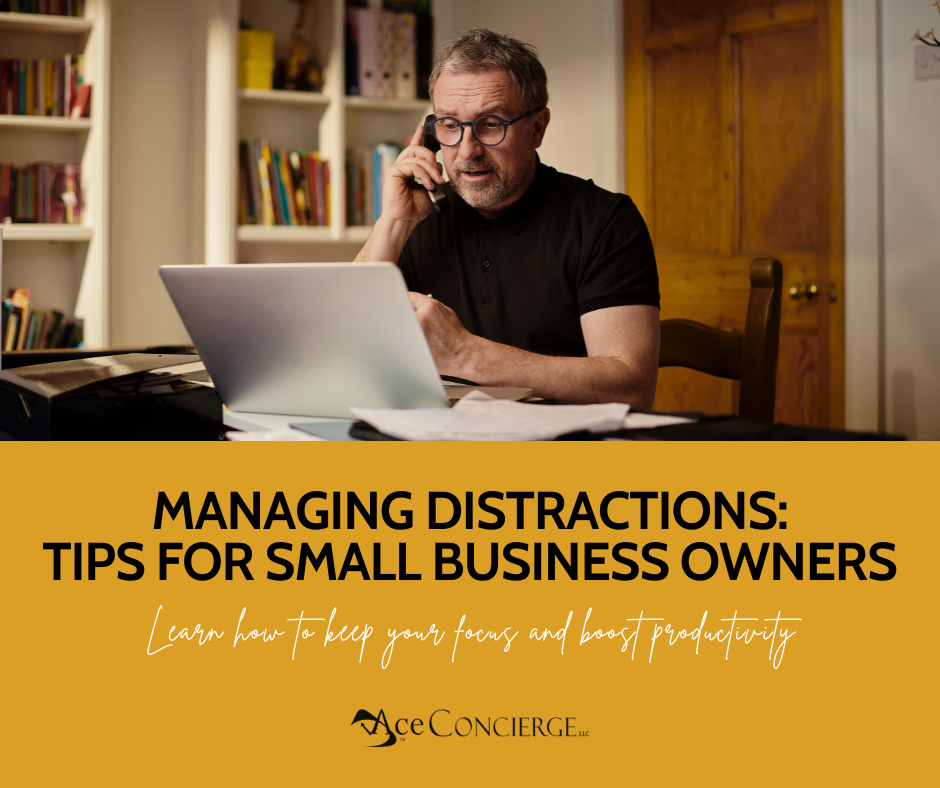
Small business owners deal with a lot daily—from managing customer inquiries and employee issues to handling supplier calls and operational tasks. It’s hard to stay on track and get things done when so many distractions exist. Feeling frazzled and stressed out is common when your plans are constantly disrupted. Many business owners feel like they’re always being pulled in multiple directions.
When they think they’ve carved out a few hours to work on a strategic initiative, an urgent order comes in, or an employee needs immediate attention. This cycle of bouncing from one fire to the next can leave small business owners wondering what they accomplished by the end of the day. The relentless nature of running a small business makes it incredibly challenging to protect your time and stay on track with essential priorities.
But with the right strategies and mindset, you can tame the chaos and reclaim your productivity.
Identify Your Productivity Pitfalls
The first step in mastering distractions and interruptions is understanding where they originated. Take a close look at your daily routine and identify the biggest culprits:
- Constant email and messaging notifications
- Unplanned drop-in visits from employees or customers
- Unexpected phone calls that derail your focus
- Multitasking between various projects and tasks
Small business owners often pride themselves on managing multiple tasks simultaneously. However, research shows that constant switching between activities can make us less efficient, as we spend more time trying to remember where we left off than actually getting work done. Once you’ve pinpointed your primary productivity pitfalls, you can start to implement targeted solutions.
Establish Boundaries and Protect Your Time
One of the most effective ways to minimize distractions and interruptions is to set clear boundaries around your time and attention. This might mean:
- Designating specific “focus hours” each day when you shut off notifications and avoid taking calls
- Implementing a system for screening and prioritizing incoming requests, whether it’s from customers, employees, or vendors
- Politely but firmly set expectations with your team about when you’re available and when you need uninterrupted time to work.
Some small business owners report feeling guilty about closing their doors or turning off their phones, worried they’re letting their team or customers down. But by protecting your focus time, you can be more present and productive when you are available—a true win-win.
Leverage Technology to Your Advantage
While technology can be a distraction source, it can also be a powerful tool for boosting productivity. Explore apps and software that can help you:
- Automate repetitive tasks and workflows
- Streamline communication and collaboration with your team
- Block distracting websites and apps during designated work periods
- Schedule and batch your most time-consuming activities
Many small business owners waste significant time toggling between different tabs and apps, trying to keep track of everything. Discovering a centralized project management tool or other productivity-enhancing technology can be a game-changer for focus and efficiency. I personally love Redbooth.
Foster a Focused Mindset
Mastering distractions and interruptions is as much a mental game as a practical one. Cultivate a mindset that prioritizes focus, discipline, and intentionality:
- Practice mindfulness and meditation to improve your ability to stay present
- Experiment with the Pomodoro Technique or other time-management strategies
- Celebrate your small wins and recognize the progress you’re making
Small business owners often find themselves in a never-ending game of catch-up. However, pausing and recognizing your achievements is essential, even on the busiest days. This can provide the motivation needed to keep moving forward.
By implementing practical strategies and maintaining a focused mindset, you can regain control of your time and become a force of productivity. Always remember, owning a small business is a marathon, not a sprint.
With the right tools and techniques, you’ll reach the finish line feeling energized and accomplished.
The successful warrior is the average man, with laser-like focus. Bruce Lee

by Ace Concierge | Virtual Assistant | Apr 24, 2024 | Business Transformation, Leadership

In today’s fast-paced, digitally driven world, it’s easy to feel overwhelmed by the constant barrage of information, notifications, and demands on our time. I’ve seen firsthand how a lack of focus and the inability to engage in deep work can hinder our ability to achieve our goals and reach our full potential. However, by embracing the power of focus and deep work, we can unlock a world of possibilities and transform our daily lives.
The Epidemic of Distraction
Recent studies have shown that the average person’s attention span has decreased significantly. The average person can now focus for 8 seconds, down from 12 seconds in 2000. This is due mainly to the proliferation of digital devices and the constant stream of information and stimuli we’re exposed to daily.
“The ability to focus is a superpower.” – Chris Bailey, author of “The Productivity Project”
This epidemic of distraction has far-reaching consequences, not only for our productivity but also for our overall well-being. Constant multitasking and the inability to focus can lead to increased stress, decreased cognitive function, and even a decline in mental health. This is where the concept of deep work becomes crucial.
In one year, the average knowledge worker allocates 103 hours to unnecessary meetings, 209 hours to duplicated work, and 352 hours to work-related discussions (Asana).
The Power of Mindfulness
One critical strategy for overcoming distraction challenges is the practice of mindfulness. Mindfulness is the art of being present in the moment, fully engaging with the task at hand, and tuning out the noise of the external world.
“Mindfulness is the ability to be fully present and aware in the current moment.” – Jon Kabat-Zinn, founder of Mindfulness-Based Stress Reduction
By cultivating a mindful mindset, we can train our brains to stay focused and attentive, even in the face of distractions. This boosts our productivity and enhances our overall sense of well-being and satisfaction. In addition to mindfulness, the concept of deep work, as popularized by Cal Newport, is a powerful tool for enhancing our focus and productivity. Deep work refers to the ability to engage in focused, uninterrupted work for extended periods without the distractions of email, social media, or other digital noise. By setting aside dedicated time each week, we can significantly increase our output and the quality of our work.
“Shallow work is what we do when we’re distracted. Deep work is what we do when we’re focused.” – Cal Newport
Optimizing Your Deep Work Sessions
Environment Optimization
Creating a dedicated workspace that’s free from distractions is key. Set up a quiet corner in your home or office with minimal visual and auditory interruptions. Use noise-cancelling headphones, ambient music, or white noise to block out external disturbances and cultivate a productive atmosphere.
Time Blocking
Implement a structured schedule with specific blocks of time dedicated solely to deep work tasks. By allocating focused time slots for intensive work, you can prioritize essential projects and minimize multitasking.
Digital Detox
Minimize digital distractions by turning off notifications on your electronic devices during deep work sessions. Utilize apps or browser extensions that block access to distracting websites and social media platforms.
Break Strategies
Incorporate short breaks between deep work intervals to prevent mental fatigue and maintain productivity. Use these breaks to stretch, hydrate, or engage in light physical activity to rejuvenate your focus.
Goal Setting
Define clear objectives and goals for each deep work session to maintain direction and motivation. Setting specific targets can help you stay on track and measure progress throughout your focused work periods.
Accountability Partners
Consider partnering with a colleague or friend who shares similar deep work goals. Holding each other accountable and providing mutual support can boost motivation and commitment to sustained focus.
Reflection and Iteration
Reflect on your deep work practices regularly to identify areas for improvement and adjustment. Experiment with different techniques, routines, and strategies to optimize your workflow and enhance the quality of your deep work sessions.
Overcoming Obstacles and Embracing the Journey
It takes real effort to break free from those ingrained habits and temptations that pull us in many different directions. But you can overcome those obstacles with patience, self-compassion, and a willingness to experiment.
Trust me, the payoff of cultivating that focused mindset is enormous – you’ll unlock a whole new level of productivity and achievement in your personal and professional life.
It’s all about finding and sticking with what works best for you. Sure, there may be ups and downs, but hang in there, and you’ll be reaping the rewards in no time.