by Ace Concierge | Virtual Assistant | Jun 9, 2026 | Business Transformation, Communication, Delegation

Some weeks just feel hard to explain.
Your calendar is manageable. Nothing is on fire. You put in the hours. But by 5 pm, you feel scattered, vaguely exhausted, and oddly behind, despite a day full of doing things.
Here is what is almost certainly happening: you are carrying too many unfinished things. If you are already looking for a framework to act on this, Winning Back Your Day is a good place to start. But first, it helps to understand why the problem exists.
A message you meant to send. A decision you have been circling. A follow-up that keeps getting bumped. A project you started and never quite closed. None of it feels significant on its own. But it does not stay individual. It accumulates, quietly, until the weight becomes the problem.
Why Your Brain Cannot Let Unfinished Work Go
Psychologists have a name for this. The Zeigarnik Effect, documented by Soviet researcher Bluma Zeigarnik in 1927, describes how unfinished tasks stay mentally “alive” in a way that completed ones do not. Your brain treats them like open programs, still running in the background, still consuming resources.
This is not a metaphor. It is neurological. Research shows that incomplete goals actively divert working memory, making it harder to focus on whatever is actually in front of you. A 2011 study by Baumeister and Masicampo directly confirmed this: participants with unfulfilled goals performed worse on unrelated tasks because their cognitive bandwidth was already occupied. The unfinished thing they were not thinking about was still thinking about them.
A 12-week occupational health study tracking 59 employees found that unfinished tasks at the end of the workweek significantly disrupted weekend sleep quality through elevated rumination and cortisol levels. The effect compounded over time: tasks left open for weeks caused more disruption than those left open overnight.
That Sunday-evening dread? It has a biological mechanism behind it.
The Accumulation Problem Nobody Talks About
Most people diagnose their overwhelm as a volume problem. Too much work, too little time. And sometimes that is true.
But often the real drag is not how much is on your plate today. It is how much is still hanging open from last week, last month, the conversation you half-resolved two Tuesdays ago.
Here is where the numbers get uncomfortable. Research by Rubinstein, Meyer, and Evans found that task-switching, which is exactly what your brain does when it is managing open loops alongside current work, can consume up to 40% of productive time. Not because you are switching tasks on purpose, but because your brain is constantly context-shifting between what you are doing now and what you have not finished yet.
That is not a time-management problem. That is a cognitive architecture problem.
Unfinished things also make it harder to accurately assess what actually matters. They cloud judgment, slow decision-making, and quietly erode the sense of forward motion that makes hard work feel worthwhile. You can be genuinely productive and still feel perpetually behind, because “busy” and “closed” are not the same thing.
What Happens When You Actually Close a Loop
Closing open loops makes room. Your thinking gets cleaner, your focus sharpens, and the background noise stops.
Send the message. Make the call. Cross it off for good. You’ll feel it immediately.
There is also good news for the perfectionists reading this: research shows you do not even have to finish the task to get relief. Studies on the Zeigarnik Effect consistently find that making a concrete plan for when and how you will complete something provides nearly the same psychological release as completing it. Your brain accepts a clear commitment as a form of closure. It stops allocating attention to monitor the loop.
That is why writing something down with a specific date attached feels different from just knowing you need to do it eventually.
The Productive Habit Most Leaders Skip
The single most underused practice for high-performers managing complex workloads is a regular open-loop audit.
Not a to-do list review. Not a priority matrix. A deliberate scan for everything that is half-done, half-answered, or half-decided, followed by a simple decision for each: close it, plan it, or consciously drop it.
Most of us spend energy trying to get better at doing more. The more valuable skill, and the one that compounds quietly over time, is getting better at finishing what you start.
A few questions worth sitting with:
- What task has been technically “in progress” for more than two weeks?
- What conversation do you keep meaning to close but keep postponing?
- What decision are you circling without actually making?
The One Open Loop Worth Closing This Week
What has been open the longest in your world right now?
Not the biggest thing. Not the most urgent. The one that keeps surfacing at the wrong moments. The one that has been half-finished longer than it should be.
Sometimes the answer to feeling stuck is not to push harder at what is in front of you. It is to finish what has been sitting behind you.
What open loop are you carrying right now, and what would it take to close it this week?

by Ace Concierge | Virtual Assistant | Jun 3, 2026 | Automation, Fractional EA

You don’t have a business. You have a very expensive job. You’re answering every email, holding every process in your head, and convinced that more hours are the answer. It’s not.
The founders who actually break free build stronger support around themselves, and the first and most important piece of that support is a Fractional EA.
Not a task-rabbit. A strategic operator who absorbs the weight of your week so you can focus on the work only you can do.
Someone put it plainly in a note that’s been circulating online: “The difference between a job and a business is whether it works when you don’t.” Most leaders I know, myself included at one point, are working IN their business every single day instead of ON it. Head down, grinding, certain that more hours are the answer.
The Burnout Is Real, and It’s Not a Badge of Honor
The hustle is breaking people.
A 2024 study found that more than 53% of startup founders reported burnout, and nearly 60% said it directly impaired their ability to lead and make decisions at critical moments. (WithDouble, 2024). Not just tired. Not just stressed. Cognitively impaired, making worse calls on the things that matter most.
And it makes sense, because the average worker, founders included, spends 57% of their time in meetings, email, and chat, and only 43% doing actual productive work. (Microsoft Work Trend Index, 2023). More than half your week is gone before you’ve touched the work that grows your business.
More hours won’t fix that. More motivation won’t either. You need a different structure entirely.
What a Fractional Executive Assistant Actually Takes Off Your Plate
Most executives hire for the skill gap they feel most urgently. A designer. A marketer. A developer. That makes sense on paper. But the resource that actually changes how you work is a fractional executive assistant.
A fractional executive assistant is a high-caliber strategic resource, not a task processor. They bring tactical expertise, emotional intelligence, and a deep understanding of your business to advance your goals and objectives. They know your priorities, understand the context behind your decisions, and operate with the kind of judgment that only comes from real experience. The best ones become a true extension of you, working with a proactive, ownership-driven mindset that ensures nothing falls through the cracks and that you stay focused on what only you can do.
Microsoft telemetry shows that employees are interrupted every two minutes, 275 times a day, by meetings, emails, and notifications. (Microsoft Work Trend Index, 2024). For founders, that number likely runs higher. The right fractional executive assistant becomes the filter between you and that noise.
Before You Delegate Anything, Write It Down
Before you automate a single thing, before you hand anything off, you need to know what you actually do.
When everything lives in your head, your entire team is working off assumptions. Things get missed, done wrong, or reinvented from scratch every time. The team feels like they must reverse-engineer your brain, which is not only exhausting for everyone but will almost guarantee a fire.
This is not a people problem. This is a documentation problem.
The fix requires no tools: for the next 30 days, document every process you touch. Every single one.
- How you onboard a client.
- How you follow up on a lead.
- How invoices go out.
- How content gets approved.
- Write it down as if you’re handing it to a capable person who has never met you.
Nothing can be automated or delegated if it only exists in your head.
Automate What’s Repetitive. Protect What’s Human.
The internet will try to sell you on full automation as the end goal. It isn’t.
People still connect with people. Your clients chose you, your voice, your judgment, your relationship. The moment your business starts to feel like an automated conveyor belt, you’ve lost the very thing that made it worth hiring in the first place. We are not meant to be processed. Neither are the people you serve.
The goal is not to remove humans from your business. It’s to remove you from the parts that don’t require you.
Automate the repetitive tasks: appointment reminders, invoice follow-ups, onboarding sequences, social scheduling, and weekly reports. Tools like Zapier, HoneyBook, Dubsado, or Make can handle enormous workflow volume without anyone lifting a finger.
- But the first call with a new client? That’s you.
- The hard conversation when something goes sideways? That’s you.
- The creative direction that makes your brand feel like something? That’s you.
Don’t let a workflow tool anywhere near those moments.
Map Your Time Before You Try to Manage It
You cannot fix what you have never measured.
Before you restructure anything, run a raw time audit for one full week. Every task, every meeting, every context switch, every time you picked up your phone because you were avoiding something harder. Tools like Toggl, RescueTime, or Clockify make this simple. What you find will likely surprise you.
82% of people have no time management system in place at all. (Lifehack Method, 2024). The average worker spends 51% of their day on tasks of little to no value. That’s not a personal failing. It’s a systems problem.
- Once you see your week clearly, you can fix it.
- Block your highest-energy hours for your highest-leverage work.
- Batch meetings so they stop bleeding into everything else.
- Give your fractional executive assistant full ownership of the calendar.
Your attention depletes. Treating it like it’s unlimited is one of the most expensive mistakes a founder can make.
The One Thing Worth Repeating
You started this business for a reason. Freedom, probably. Some version of it. Time, impact, autonomy, or simply not wanting someone else deciding how your days go.
None of that happens while you’re the bottleneck. None of it happens while you’re answering every email, sitting in every meeting, and holding every process in your head.
The founders who build something real, something that outlasts their daily involvement, aren’t working harder than you. They built stronger support around themselves, documented what they knew, automated repetitive tasks, and protected the work only they could do.
That’s it. That’s the whole answer.
Where to Start This Week
- Run a 5-day time audit. Write down everything you do and how long it actually takes.
- Pick your top 3 repetitive tasks that could be automated or handed off this month.
- Document one core process from start to finish.
- Research one fractional executive assistant who works in your space.
- Block two 90-minute deep work windows next week. No meetings. No Slack. No exceptions.
The business that runs without you starts with one decision: that your time is worth protecting, and that you’re done being the thing standing between your business and its next level.

by Ace Concierge | Virtual Assistant | Dec 30, 2025 | Business Transformation, Delegation, Leadership

It’s about thinking better.
Most leaders don’t struggle with delegation because they want control.
They struggle because they care.
They care about quality.
They care about outcomes.
They care about being responsive, reliable, and competent.
So they hold on.
They review everything.
They stay looped into details they no longer need to carry.
They keep saying yes because saying no feels irresponsible.
And slowly, something subtle starts to happen.
Their thinking gets noisier.
Decisions take longer.
Clarity feels harder to access, even though nothing looks “wrong” on paper.
This is where delegation gets misunderstood.
Delegation is often framed as a time-saving tactic.
That framing undersells the real issue.
The highest cost of not delegating is not time.
It’s cognitive load.
Every unresolved task.
Every follow-up you are tracking mentally.
Every operational detail you are “just keeping an eye on.”
They all live somewhere in your head.
Psychologists call this cognitive load. It is the total amount of mental effort being used in working memory. When that load stays high for too long, decision quality declines and mental fatigue increases. The research is clear on this point. The brain has limits, even competent ones (Sweller, Cognitive Load Theory).
Leaders feel this before they can name it.
They reread the same email.
They delay a decision they usually would make quickly.
They feel busy but oddly ineffective.
Not because they lack discipline.
Because their thinking space is crowded.
Delegation, done well, is not abdication.
It is design.
It is deciding what kind of thinking deserves your attention, and what type of work can be carried out by a system or another person.
Peter Drucker wrote that executives are paid to make decisions, not to do work that others can do just as well. His core belief was simple. Executive effectiveness depends on protecting time and attention for contribution, not activity.
When you delegate properly, three things happen.
First, mental noise drops.
Second, decisions get cleaner.
Third, you regain the ability to think ahead rather than constantly react.
This is why effective delegation often feels like relief before it feels like efficiency.
Letting someone else own work means tolerating a brief period of uncertainty.
Will they do it the same way?
Will they catch what I would see?
Will this actually save me effort?
That discomfort is real. It is also temporary.
Stephen R. Covey described delegation as a trust-based agreement, not a task handoff. Clear expectations. Clear outcomes. Clear ownership. When those are present, delegation becomes leverage rather than risk.
What most leaders discover is this.
The moment someone else is truly accountable, their own thinking improves immediately. Not because the work vanished, but because it no longer lives in their head.
It is not dumping tasks.
It is not disappearing.
It looks like this:
Clear outcomes instead of vague instructions.
Defined ownership instead of shared responsibility.
Context instead of constant oversight.
John C. Maxwell captured it. If you want to make a bigger impact, you cannot be the one doing everything yourself.
Delegation creates space.
That space is where judgment sharpens.
That space is where leadership actually happens.
They start asking, “Why am I holding this at all?”
That question changes behavior fast.
Delegation no longer means a loss of control.
It becomes a way to protect clarity.
And clarity is not a soft benefit.
It is a competitive advantage.
Delegation isn’t about doing less.
It’s about thinking better.
And better thinking is what every organization quietly depends on.
by Ace Concierge | Virtual Assistant | Dec 23, 2025 | Business Transformation, Entrepreneur, Executive Administration, Executive Assistant
High performers often blame themselves. Structural productivity problems usually cause the struggle. When the calendar fills, the inbox overflows, and important work slips through the cracks, leaders think, “I need to be more disciplined.” They wake up earlier. Work later. Add another productivity app. Try a new routine.
It feels noble to see it as a personal failing. It also misdiagnoses the problem.
What Looks Like a Discipline Problem Is Structural
What looks like a discipline problem is often a structural problem: you are operating in a system where you are responsible for both leading and holding everything together.
Look at the shape of your day. You are making high-impact decisions, yes. But you are also:
- Screen and triage messages.
- Schedule and reschedule your own meetings.
- Follow up on tasks others promised to do.
- Fill gaps between departments to ensure nothing falls through.
- Stay copied on threads “just in case” to keep everyone comfortable.
By the time you reach the work only you can do, you run out of mental energy. Focus feels like a luxury. You try to squeeze deep thinking into early mornings, late nights, or weekends. Then the story becomes: “I just need better self-control.”
What Happens If the Structure Changes
Imagine, instead, that the structure around you changed, but you, as a person, did not. Same brain. Same habits. Different environment.
In that world:
- Your calendar is designed around your highest-value work, not first-come, first-served requests.
- Routine decisions and recurring tasks are handled by someone who understands your preferences and can execute them on your behalf.
- Threads you do not need to see never reach you.
- Meetings are filtered, prepared, and followed up on without requiring you to lose any additional time before or after each one.
You did not suddenly become more disciplined. You became supported correctly.
The Quiet Power of a Strong Operator
That is the quiet power of having a strong operator around you. An operator does not mean “someone to take tasks off your list.” It means:
- Translating your goals into concrete action and sequencing.
- Deciding what deserves your attention and what does not.
- Creating structure so decisions and projects move even when you are not looking.
- Guarding your time from the thousand small pulls that look harmless but add up to a completely hijacked week.
Most leaders underestimate how much energy they spend compensating for the lack of that role. They call it “being hands-on” or “staying close to the details.” In reality, they are patching holes in a system that expects them to be founder, strategist, project manager, and admin at once.
Fixing Structural Productivity Problems
You do not fix that with a new morning routine. You fix it by adjusting the mix of work on your plate and how that work reaches you. You fix it by recognizing that your time and attention are scarce assets that require infrastructure, not just more willpower.
So before you commit to the next wave of “I’ll try harder,” ask a different question:
If your calendar, inbox, and projects were redesigned around the work only you can do, how much “lack of discipline” would actually remain?
by Ace Concierge | Virtual Assistant | Dec 17, 2025 | Business Transformation, Entrepreneur, Executive Assistant
You open your inbox at 7 a.m. and realize the day already owns you. Meetings, emails, operational fires… decisions multiplying faster than you can track. Somewhere between the urgent and the important, the vision that drove you here starts to blur. The milestones, the wins, the late nights. They all matter, but the daily grind often swallows them whole.
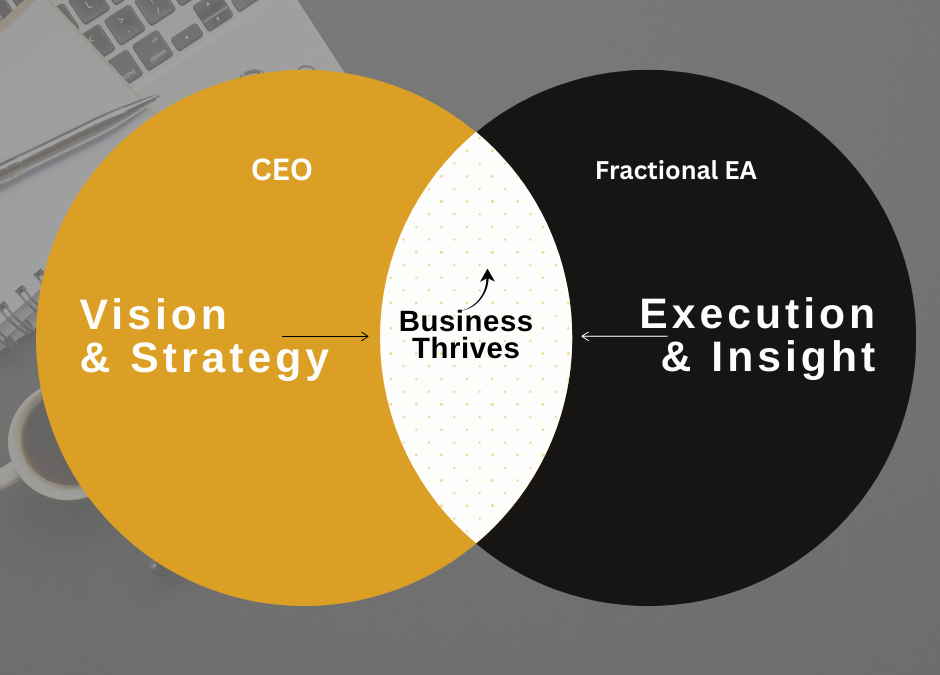
I know this feeling. I’ve run my own business for 23 years. I’ve juggled priorities, faced setbacks, celebrated wins, and carried the weight of countless small decisions. That experience shapes how I support other entrepreneurs and executives. I don’t just execute tasks; I anticipate what truly matters and act as a partner invested in your success.
Because I’ve been in your shoes, I understand the difference between getting things done and getting the right things done. I know the stress of constant operational noise, the mental load of decisions, big and small, and the toll of putting out fires that never seem to end. And I know that the right support can transform not just your day-to-day, but your entire business.
Why a Fractional Executive Assistant is different
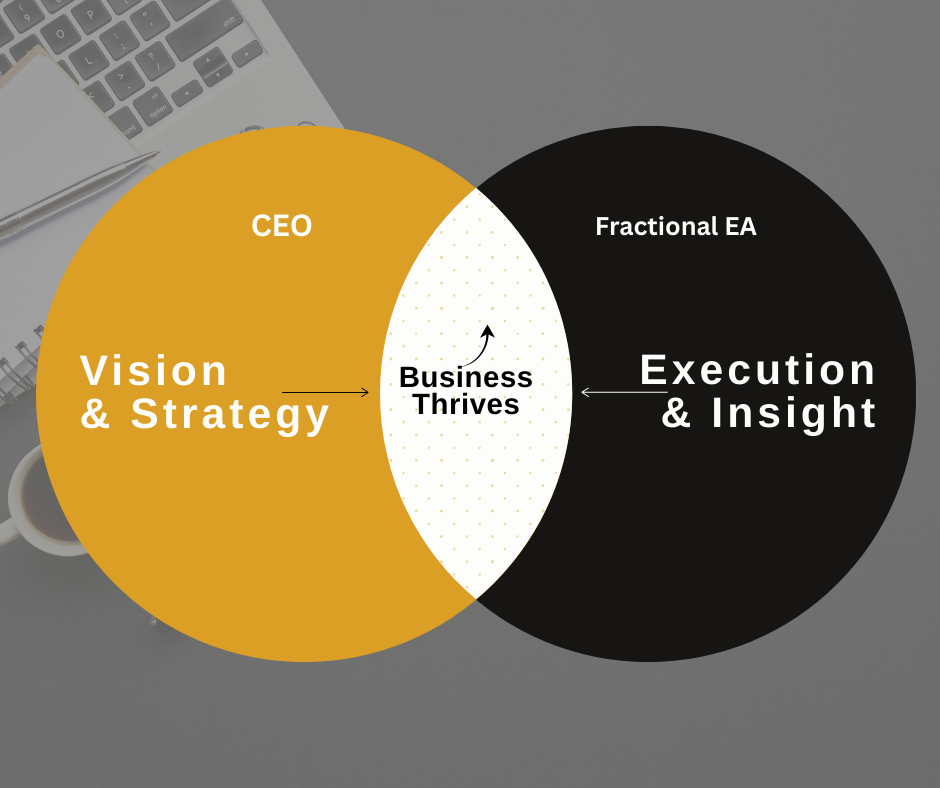
Most virtual assistants or call centers focus on completing tasks. A Fractional Executive Assistant, especially one who has run a business, brings something entirely different: perspective, foresight, and partnership.
Here’s how it works in practice:
- We’ve been in your seat: Running a business isn’t just a job. It’s a lifestyle, a mental marathon, an emotional journey. We understand the highs and the lows, the unexpected pivots, and the wins that feel both monumental and fleeting. That understanding lets us anticipate your needs in ways a task-focused assistant can’t.
- We know your business inside and out: Every company has a unique rhythm, culture, and set of goals. We take the time to understand what makes yours tick. Every action, every process, and every decision we take aligns with your vision, not just your to-do list.
- We think ahead: A Fractional EA doesn’t wait for instructions. We notice gaps before they become problems, flag opportunities before you ask, and keep projects moving forward.
- We adapt to you: Cookie-cutter solutions rarely work. Every process, workflow, and approach is tailored to your priorities, pace, and style.
Instead of being swallowed by the daily grind, you have someone managing the details, protecting your time, and keeping the bigger picture intact. It’s not just checking boxes. It’s ensuring the work you do moves your business forward. Every email answered, every schedule coordinated, every project tracked is done with your goals in mind. That level of awareness changes how you experience your day and what your business can accomplish.
The difference comes down to experience
Running a business for 23 years teaches lessons that no manual or checklist can provide. You learn to anticipate challenges, recognize patterns, and understand the invisible pressures that can derail even the most capable leader. That perspective enables a Fractional EA with business experience to provide support beyond task management. It becomes strategic, proactive, and deeply aligned with your goals.
Consider the mental load of a CEO: endless emails, urgent meetings, operational fires, decisions large and small. Now imagine having someone who not only handles those tasks but understands which ones actually move the business forward, which ones can wait, and which could become opportunities if addressed differently. I notice the gaps most support misses; the small cracks that grow into big problems, and the tiny opportunities that change everything. That is the impact of partnering with someone who’s been in your shoes.
What this looks like day to day
- Reclaiming time: Instead of spending hours coordinating schedules, responding to routine emails, or chasing down information, a Fractional EA manages these details for you. Your calendar, communications, and operational needs are all handled.
- Reducing stress: The mental load of running a business can be exhausting. Knowing someone you trust who keeps the details organized gives peace of mind.
- Elevating business potential: Freed from daily operational noise, you can focus on growth, innovation, and opportunities that excite you.
It’s human, not transactional. Every action your EA takes reflects your priorities, strategy, and vision. That’s what turns support into partnership, and tasks into impact.
The Fracional EA is a trusted partner
Beyond tasks and strategy, this work is about trust. A Fractional EA who’s also a business owner doesn’t just execute instructions; they think, decide, and act in ways that protect and advance your business. That trust enables seamless delegation, confident decision-making, and the peace of mind that comes from knowing your business is in capable hands.
Because I’ve run a business myself for more than two decades, I understand the stakes. Your time, energy, and focus are finite, and every hour spent on the wrong thing comes at the cost of growth, creativity, or peace of mind. That’s why I partner with leaders to ensure their daily work aligns with their bigger vision, and that the business thrives while they do too.
Ask yourself:
- Who’s truly helping you run your business, and who’s just keeping the lights on?
- Are you spending your energy on what moves the needle, or reacting to the endless noise?
- If you could hand off the details to someone who gets it, how would that change your day and your business?
The proper support isn’t about doing more. It’s about understanding the business, anticipating what matters, and acting before you even have to ask. That’s the difference a Fractional Executive Assistant with lived entrepreneurial experience brings.
When your support understands your business as you do, your business can not only function but also thrive. And you can finally reclaim the time, clarity, and energy to focus on what really matters.