
by Ace Concierge | Virtual Assistant | Dec 20, 2016 | Delegation, Entrepreneur, Time Management, Virtual Assistant

Let’s get real about time management. Sure, scrolling through social media and completing daily to-dos are satisfying, but will they translate to success? Likely not! These activities are like sidekicks, important to keep the business chugging along, but they won’t be the superhero bringing in the major cash.
What is the best use of your time and expertise?
Your core genius: something you love to do, is effortless, creates a sense of joy and contentment, generates a fire within and time disappears. It could be coaching, writing, graphic design, speaking, leading, selling, training, motivating, marketing or whatever your passion is. When you are focused on your CG, you are alive, vibrant, and producing outcomes.
As an entrepreneur, when you can maximize your potential by focusing on your core genius, you not only follow your passion but can devote your time ON your business rather than IN it. You become more productive and efficient. While many daily business tasks require attention, it doesn’t necessarily have to be on your time. Delegating the lower return projects and tasks gives you back your time to build your business, develop strategy, nurture relationships, foster loyalty, seek partnerships, and focus on your bottom line.
Compare the individuals, the business owners, who dedicate their time to every task, every project, even those that they don’t like, don’t truly have time to do, or the ones that are more menial “time robbers.” These people are taken away from their core genius and focused on the back end, admin-type projects instead of building their companies and concentrating on income-generating projects.
“Most entrepreneurs spend less than 30% of their time focusing on their core genius and unique abilities. In fact, by the time they’ve launched a business, it often seems entrepreneurs are doing everything but the one thing they went into business for in the first place.” Jack Canfield
Everything we do is an investment of our time. When you choose to watch television or engage on Facebook that is an investment of your time. In many ways, time is more valuable than money, as you always have the opportunity to make more money, but you cannot recreate lost or wasted time. It is gone forever. If you think of time as a commodity and all of your actions/choices as an investment, it may change how you approach your daily activities.
Think about the return on your time invested. In a recent article by Anthony Iannarino, “Return On Time Invested,” he suggests measuring each activity, the time you spent, and the return. If there was no return on your time, then you must realize that that task or activity is not worth doing. A better use of your valuable time is to focus on those activities that produce a desired, profitable, and rewarding outcome.
Leveraging your time and effort is a fundamental strategy for success. There are only so many hours in the day that you can work and by only using your time, you can only accomplish so much. When you choose to utilize other people’s time via delegation, you intensify your productivity and efficiency to an extraordinary magnitude. It feels great to do more in less time.
- Eliminate unnecessary activities
- Prioritize so you focus your energy on those tasks that provide the highest rate of return
- Set long and short-term goals with action steps, motivating you and keeping you on target
- Learn how to effectively delegate
- Outsource non-core tasks/projects
Action Step:
- Identify the daily activities that are devouring your time by keeping a journal: logging activities, projects, and time spent
- Build a plan to delegate the time robbers that are taking you away from your CG
- Call Ace Concierge to discuss your delegation strategy and project timeline

by Ace Concierge | Virtual Assistant | Sep 10, 2015 | Delegation, Virtual Assistant

Whether you are a budding entrepreneur or an established business, you can’t do it all yourself. Who can possibly wear all of the hats required to operate a successful viable business? Not many that I know of. It takes a cohesive team to manage each division of your business. You may already work with an attorney, a CPA, or even a graphic designer, but what about the balance of your everyday business operations? The daily administrative and backend details that keep you flowing, productive, and focused on your core genius?
A virtual assistant can change your life, giving you back your day so you can work on the tasks that will take your business to incredible new places. Brandon Turner
Partnering with a Virtual Assistant is a low cost, high payoff solution to enable you to work ON your business rather than IN it. This is such a cliche, but it holds true. If you are buried in the everyday, mundane activities then you don’t have the time or energy to focus real efforts on business development, client retention, troubleshooting or building relationships. And, as you know, your online presence depends on developing a human, touchable brand.
What can a Virtual Assistant do for you?
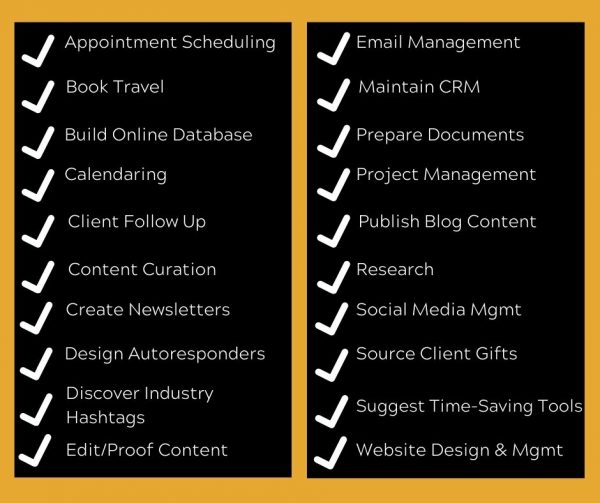
This is the simple shortlist of what you should delegate to a virtual assistant. There are literally hundreds of tasks and projects that you do within your business that aren’t the key drivers to generate income and don’t represent the best value of your time. If you’d like to see where your time is spent (not invested), keep a daily log of what you do, how much time you spend on tasks, and what is accomplished. You may be surprised at the end of the week to realize that you are more “busy” than productive.
“As all entrepreneurs know, you live and die by your ability to prioritize. You must focus on the most important, mission-critical tasks each day and night, and then share, delegate, delay or skip the rest.” Jessica Jackley
Take back your time to scale your business with a Virtual Assistant partnership.

by Ace Concierge | Virtual Assistant | Sep 24, 2014 | Content Marketing, Organization, Productivity, Small Business, Time Management
 Bleary eyed and reaching for your coffee, you boot up your computer and start your daily diet of content consumption. It is a filling nourishment of words, intel, fired up neurons and brain overload. Or at least it can be. Personally, I can spend hours reading all of the articles on social platforms, news aggregators, daily digests, emails and newsletters. Sometimes I think my head will explode.
Research demonstrates that we take in five times as much information as we did 30 years ago, raising huge challenges to organize it all.
We are drowning in data.
In a 2010 LexisNexis study, 62% of workers felt as though their quality of work suffered at times because they couldn’t sort through the information they needed fast enough.
There is so much to digest and learn. I could be bookmarking and saving content all day long. There are hundreds of talented bloggers and business owners sharing their incredible knowledge of tools, tips, recommendations and experiences. It can be overwhelming. Think of how many times you get sucked in to the black hole searching, clicking, and redirecting. It’s a vortex.
How do you manage all of the content? There are tools to organize your content or to help you search and save but you also need to decide what you are going to do with the information. Daniel Levitan, author of “The Organized Mind,” says “Whenever we feel overwhelmed by everything we need to keep track of in life, we talk about wanting to get organized.”
You’ve chosen your sources, thought leaders and industry favorites to follow and “study” in your own college auditorium of higher learning. That’s what it sometimes feels like for me and without the outrageous tuition costs.
What is the purpose? Business or personal? How does it apply to your business? Customers? Colleagues?
What are your content goals?
- Self-education
- Curation
- Repurposing
- Inspirational
- Research
- Love of reading
If you’re like most of us, you have a business to run and can’t spend every waking moment culling and sifting through information. It’s a full time job. Who has the time to sit and read all day when you are trying to live the entrepreneurial dream?
Use filters and keywords help to refine your searches.
This will help to save time and improve your overall content management. If you have some systems in place, it will be much easier to sort through all of the posts you want to read and combat your information hangover.
Researchers tend to agree that it’s not the volume of information that is the problem; it’s our inability to organize and process it all without experiencing “information overload, or what neuroscientists like to call “cognitive overload. Saga Briggs
| Research |
Organize |
| Social Media |
Evernote |
| BuzzSumo |
Readability |
| Scoop.it |
Spreadsheets |
| Tagboard |
Swipe files |
| RSS feeds |
Bookmarks |
| ContentGems |
Files and folders |
| Hootsuite Content Feature |
One Note |
| Flipboard |
Feedly |
| Alltop |
Google Drive |
| Inbound.org |
Dropbox |
| Biz Sugar |
Pocket |
| Topsy |
Ubernote |
| Feedly |
Powerpoint |
Design a system that works for you to enhance your time management and productivity as well as minimize on the extreme overload of data and what to do with it all. A method to your madness is guaranteed to keep you on track and focused. Systems and processes are the architectural structure of your success and productivity.
Establish some routines; otherwise you hit a wall, letting things go and opportunities are forfeited. The routines could be time limits or specific times you will be searching, saving and filing. Time block when you will surf. If you discover something important during the day, “save” it somewhere to revisit later. Don’t let it be a distraction and take you away from your current task at hand.
Decide what to keep or implement NOW based upon it’s perceived impact on your goals. Prioritize to your needs. Is it something you must have or must know? If so, how soon will you be needing it? Use your organizing tools to keep track of the data, being mindful of how you will use it and when. Some articles may have a more immediate use while others are purely for reference. You decide, but take action.
Declutter: remember to go through your folders or storage options so they haven’t blossomed into an overload of organized data. Purge the old to make room for the new. There’s no sense in just letting everything pile up and multiply as that will defeat the purpose of your systems.
How do you challenge your content zombie? What helpful tools can you suggest?

by Ace Concierge | Virtual Assistant | Jul 16, 2014 | Organization, Small Business, Time Management
 We have all heard that time and again, but it holds true. If you live and work in disorganization, your mindset and output will reflect your surroundings. Sure, we have some disorder or “organized piles” of stuff, but when there is overload, it overflows.
Clutter influences the way you work and the way you live. It impacts your brain. Learn to effectively manage versus just restyling the mountains of possessions, papers, contracts, or whatever lurks in your office or home. Streamline your physical and digital environment for success and focus.
“A recent survey says a disorganized workspace can lead to decreased productivity and unprofessional behavior.” Inc Magazine.
When you create a more structured environment you become more efficient and effective. You are no longer scrambling to locate important papers, files, emails or even your keys. Your time management increases as does your personal and professional productivity. Your setting is not just about physical space but mental as well. If you reside in chaos or mayhem, it does transmit into your work habits and daily living.
Your surrounding clutter competes for your attention, distracting your focus and thought process. I personally must have a clean and organized environment or I will only be thinking of what may be in the sink or if laundry needs folding. Everything has a place and it must be there when I work. Sure, a little OCD but I run my business the same way.
“When your environment is cluttered, the chaos restricts your ability to focus. The clutter also limits your brain’s ability to process information. Clutter makes you distracted and unable to process information as well as you do in an uncluttered, organized, and serene environment.” Princeton University
According to the National Association of Professional Organizations, paper clutter is the No. 1 hindrance for most businesses. Some studies conclude that the average person wastes 4.3 hours per week searching for papers, which adds stress and frustration to the workplace while reducing concentration and creative thinking. Clutter creates chaos, untidiness and ineffectiveness in every aspect your life and has the great potential significantly influence your personal productivity.
When personal productivity declines, every aspect of your life will be impacted.
Fired up and ready to reclaim your productivity?
- Set aside time weekly to manage and organize information
- Clean out your inbox
- Use cloud storage
- Put things in their proper place when you are finished – don’t merely move away. Put it away
- Always organize your desk at the end of the day
- Establish routines for clearing the mind overload
- If you must file, then do it. Don’t let items sit on your desk, counter or inbox. It is disrupting
- Don’t keep things that aren’t necessary or vital to your existence. Aunt Betty’s tattered hair ribbon won’t garner money on on the open market. Loving memories last longer
- “More” doesn’t mean more – it translates into jumble and disorder which means distractions. Clear off counter tops and desk space so you can function.
- Donate to charity
- When you bring in one new item, throw out two
- Work on one room at a time until it “feels” good
- If you haven’t used or viewed it in 6 months, do you really need it?
- Know that your value is not your stuff. It does not define you
- Create deadlines to ensure you stick to your toss it and organize program
- Once you have cleaned and decluttered a room or space, maintain it
Decluttering and clearing out the chaos, both physically and spiritually will help you gain clarity toward a more productive life. Make the time to invest in yourself.

by Ace Concierge | Virtual Assistant | Jul 9, 2014 | Delegation, Small Business, Social Media, Virtual Assistant
 Do you feel as though your day flies by without a minute to spare? Maybe you even missed lunch, got home late, or forgot to pick up something at the store? Gosh, I am sure you know the feeling. You are constantly on the go and doing something BUT is that “something” productive and getting you closer to your goals? Simply being busy isn’t results oriented.
Being productive means getting things done. As in you’ve actually accomplished something, not just filled out a fake status report marked “complete.” Learn how the work you do makes it to the finish line and how it adds to the bottom line of your company. Craig Golightly
At the end of the day have you reviewed your long laundry list and found that you still have a lot of washing to do? Well, you are not alone. Your entrepreneurial spirit is driving you to do it all and be it all, no matter what the cost. No matter what the activity.
You should seriously consider the busyness and the low payoff tasks versus the real core drivers of your business that produce the income. The tasks and projects that ONLY you can and should do.
If you are entrenched with 10, 20+ hours a week on social media management, curating content, writing, editing, proofing and scheduling blog posts, calendar management, writing newsletters, creating documents and templates or acting as the project manager, then WHO is operating your business?
Value your time!
Honor your skills!
As I mentioned in: “Leveraging Time and Your Core Genius,” when you are able to maximize your potential by focusing on your core genius, you become more productive and effective. While there are many daily business tasks that require attention, it doesn’t necessarily have to be on your time. Delegating the lower return projects and tasks gives you back your time to build your business, develop strategy, nurture relationships, foster loyalty, seek partnerships, and focus on your bottom line.
I received an email from an exceptionally valued long-time client who shared her To Do list with me. She stated: “These are just a few of the things I need to grow my business – and I am failing at doing them, but when I do, it totally pulls me away from the work I NEED to do that is billable.”
Her statement firmly relates back to leveraging time and focusing on what you do best to build and cultivate your company.
The following are some of the tasks and projects that she must faithfully devote her time doing in order to continue to expand her business. What an expansive undertaking! Remember: Time is money! Invest wisely.
Are all of these her core genius? Certainly not, however; they are must do activities for business development and progress.
- Keep my Social Media up to date for all these areas:
- Links, research, updates
- Linking to all other things I do – I.E.: when I write a blog post, making sure it is pushed out to every single place.
- Doing key word searches in Google to make sure key wording is in every article for the most relevant search terms.
- Document management systems – keep all my documents on the shared drive (in the cloud) up to date and in order by first cleaning up the mess I have going now… – including but not limited to:
- Client files
- Website files
- Corporate files
- Marketing materials
- Research documents etc.
- Source potential clients in my geographical location who are in start-up to med-sized businesses, active in Social media and who may or may not need idea sessions to get their business further along
- Requesting a meeting for me
- Setting it up
- Reviewing and updating my calendar so I keep better track because I always fail to put things in calendars
- Meet with me via Skype once a week to see what needs to be done and doing it
- Use my contract template documents for me and update them for each new client as it takes me days to get to these.
- Review and edit all files sent to all clients or outgoing parties
- Do all my research for the topics I write about so they can be backed by data
- All invoicing and receipts for clients
- All sourcing of industry related expert themes
- Managing my LinkedIn polls
- Creating my surveys for clients
- Creating templates for all my follow-up reports for each facilitated session
- Taking all of my current documentation and finding ways of repurposing it
- Taking all of my product development efforts and interviewing vendors
- Responding to and dealing with all incoming email from all websites with initial contact to let them know I am here and I did get their email, and when I will respond
- Setting up of appointments with clients, prospective clients, peers
- Researching all speaker opportunities and sending out my speaker packages and filling out the applications
- Researching all clients who have recently undergone a merger or acquisition and sending the change management brochures out to them
- Develop templates for my processes so I am not reinventing the wheel every time I work with a new client
- Updating my BIO on every single software site I have it listed (and tracking where that is) so I can ensure it is always consistent every time I change it
- Updating the company project software for me at the drop of an email – because I cannot always log in
- Managing the company project software and following up with deadlines of contractors
- Using your network to get them to post my quotes on quote sites so I continue to build credibility
- Sourcing the least expensive book editors to edit my writing of each chapter of the book I never have time to edit.
- Kicking my butt and making sure everything I say I “want to do” becomes an actionable item in the company product software and is due to YOU to review for me – rather than my leaving it in there without a date and just “wishing” it would happen
So, after reading this list, how many of these tasks do you hold on to that keep you working IN your business rather than ON it? We sometimes don’t realize all of the day to day activities that go into growing our companies, as they have become second nature while we are on autopilot.
All of these tasks and projects are NECESSARY but divert your attention from the most important facets of your company which ONLY you can do. These are the low payoff, non-income generators that aren’t the best value of your time.
ACTION ITEM: Record every single task, project or activity for one week, noting which line items are income producers, core genius or something that was a time robber and should have been outsourced.
Come back to me in one week and share your list. Let’s talk strategy and outcomes.
“One of the most critical was the ability to learn how to effectively delegate. It is a skill that every upstart entrepreneur must master if they wish to grow their business. Without delegation your business will be limited by your own time and energy.” Matthew Swyers