by Ace Concierge | Virtual Assistant | Feb 15, 2023 | Business Transformation, Executive Assistant, Productivity, Technology, Virtual Assistant
by Ace Concierge | Virtual Assistant | Aug 9, 2022 | Business Values, Customer Service, Leadership
If you’re a business owner, you probably wonder if you should focus solely on being transactional or transformational. It’s important to recognize the difference between the two.
Transactional in business is all about what you are asking for. You sell a product or service, without deepening the relationship too much. But as a business owner, you wish to build a long-term relationship that comes from transformation. You want to use your product/service to change someone, enrich their lives, or teach them something they didn’t know before.
Business owners often focus on ‘transactional’ to-do’s because they feel more productive, but ‘transformational’ moves will help you in the long run
Most businesses focus on getting more customers & clients. The people who rise above these transactional relationships and transform them into something more meaningful are the companies who will thrive. They are the ones who will have a family of customers, clients, and friends that they do business with over time.
Transformational vs transactional: what’s the difference?
In short, a transit transaction is characterized by an exchange of value for value. In contrast, transformative transactions are characterized by an exchange of value for some sort of non-market good. Transformative transactions may be characterized by psychological relationships between seller and buyer that are more durable and trusting than those typified by transactions. Or transformative transactions may be characterized as providing some sort of benefit to one party that is not directly related to the market value of the good or service involved in the transaction but is valued nonetheless.
Transactional activities are those that help us check off our lists and feel productive (e.g., responding to emails), while transformational actions/behaviors are ones that increase productivity over time (e.g., building relationships). Consider this example, when trying to build muscle and increase fitness levels, it is not enough to lift heavier or run longer. Your body is a system and requires proper lifting technique, a solid program, sleep, mind/muscle connection, balanced hormones, micro/macronutrients and recovery. These essential components, along with so many other physiological elements is the nitty gritty groundwork for performance, endurance, strength, and hypertrophy. When a goal-oriented athlete does not consider the myriad of foundational building blocks, their success will not only be limited, but their body could actually enter a catabolic state.
7 strategies to support your long game
- Draft a list of what you want to accomplish through change and transformation
- Set aside time for an honest, deep dive into your organization, removing emotion and ego, how is the health of your business? Your staff? Revenue? Clients? All the things?
- Avoid burnout and overwhelm by focusing on one level of your business, i.e, operations, technology, human resources, business model, customer journey, etc
- Commit to solving problems at their core, the root cause, because a quick fix or bandage is just a transaction
- Focus on your future goals to help you create more meaningful strategic action steps
- Invest 100% in the process and mindset
- Gain staff buy-in through education and empowerment
If you maintain an emphasis on transactional business practices, you will find yourself dealing with clients who are less committed and not reaping the long-term benefits of solid relationships.
The goal of business success doesn’t mirror a travel itinerary, but instead, nurtures loyal client relationships, a strong corporate culture, and transforming the customer experience.
In the end, it’s really all about value. If you can prove to your customers (and all stakeholders) that you’re providing value, not just selling products and services, then you’ll be more successful than those who are simply trying to run their business in a transactional manner. Think about your own habits. Do you prefer businesses that treat you as a customer or as a valued member of their community?

by Ace Concierge | Virtual Assistant | Jan 18, 2022 | Productivity, Technology

Your technology needs to optimize your efficiency, otherwise, you become buried in useless tools that only suck up your valuable time, and bottom-line, making you less efficient and productive.
If you’re like most business owners, you employ a variety of devices, utilize various online platforms, and have downloaded a host of apps and programs to help you conduct your daily life and business.
We all love the shiny objects and opportunities to test new tools or play with something we ‘think’ is more fun or better than what we currently have. The grass is always greener, right?
Well, it isn’t. Not ALL of the time.
“Shiny Object Syndrome” and is relatively commonplace amongst business owners who don’t have streamlined business processes to handle everyday operations and organize new ideas. Jennifer Goldman, Business Transformer, CFP
Your fancy tech and tools could be bogging you down. Whether you’re tied to managing the tools, remembering logins (there’s an app for that), creating profiles, figuring your goals and desires for data mining and outcomes, collecting data, sorting data, applying data, thinking about the data, you could be effectively drowning yourself in a sea of wastefulness. As a result, you’re creating more busywork and To Dos to get done.
STOP! Take a minute to consider every tool or platform you use on a daily or monthly basis. List them on paper (or your computer). Did you remember EVERY single one?
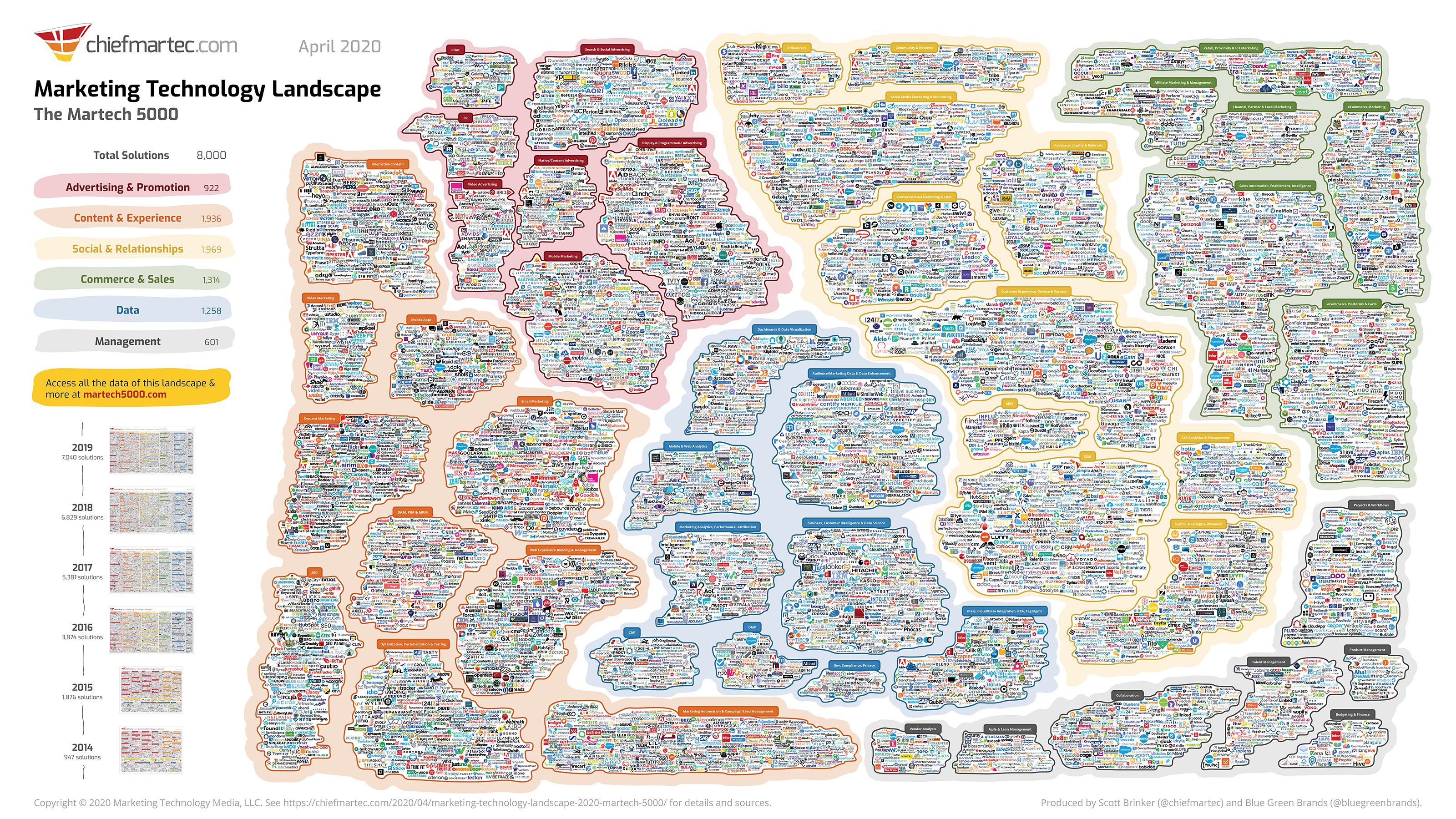
According to chiefmartec.com, in 2020, there were over 8,000 tech platforms! Click HERE to see their graphic and blow your mind.
In this 2016 VentureBeat article, their graphic depicts an extensive myriad of platforms to manage inside sales. Here we are in 2022, you can bet that the number of programs has multiplied exponentially.
Let’s dial it back to you and your set of tools and software programs.
Questions about your tech stack:
- Do the tools add to or take away from your collaboration?
- Do your tools add REAL value to your operations and desired outcomes?
- Do your apps offer full integration with each other?
- What would you lose if one of them shut down?
- Is there any redundancy in capabilities or features?
- Are these apps ALL on a do-or-die basis?
- Are there tools you can do without?
- Does the costing fit within or exceed your budget?
- Are you gaining a competitive edge or just using the latest tool?
What will you do with the results of your Tech Stack probe? It is up to you to vet each tool for value-add and benefits across your organization. The investment you make should meet your goals while supporting your team, collaborative partners and corporate mission.
If your tools fall short, or your tech stack looks more like a tornado of shiny objects, create a spreadsheet or chart of choice, to clearly outline the features, benefits, and costs. There’s nothing worse than worthless clutter.
What’s your plan to optimize your tech stack?

by Ace Concierge | Virtual Assistant | Nov 19, 2021 | Organization, Productivity, Time Management

If you work from home, your office desk may be hindering your productivity. Have you ever entered your office to find it in disarray? Or maybe you have spilled coffee or tea all over your desk?
That’s a case of having to get your home office desk organized urgently so you can get your work done.
But why wait until you spill coffee or soda all over your work?
Your Organized Home Office Desk Helps Increase Your Productivity
How you wonder? According to Forbes, the typical executive today wastes almost one month a year searching for lost information.
Imagine a whole month looking for something that if you were organized you would have saved that much time?
What would you do with a months’ time? You could actually take a vacation! Or work more and make more money and still take a 2-week vacation. Imagine that?
How to Get Your Home Office Desk Organized
- Take everything off your desk and dust it. Make it shine.
- Next only put your laptop on the desk.
- Then add items like a pen and pad near your dominant hand. If you have several pens/pencils, put them in a container and leave just one on the desk. This helps you focus more on one thing and not multi-task.
- Only keep what you need on your desk. Anything that you reach out for often or have to leave your desk for.
- Keep some open space, it helps your mind wander and be more creative. Creativity for running a business is important as you need to make changes and pivot for your success.
- Do not keep a pile of paper on your desk. Only the important few pieces.
- Next, make sure your laptop desktop itself is not cluttered.
- Keep a to-do list and schedule nearby on your office desk.
- Hang some inspirational quotes or photos on the wall of your home office.
Why Declutter?
By decluttering your office desk space, you feel better. When you feel better, you can work better and be more productive and creative.
Also start decluttering the other spaces around your home office desk. For example, drawers and shelves. Keep them simple and clean.
Next time when you enter into your office home space you will feel refreshed and ready to begin working. You won’t be thinking about all the stuff you have to clean as you work from home.
Organize the Rest of the Office
Now that you have your office desk organized, you can move on to the other areas of your room. Whether it be in the drawers or other pieces of furniture keep things to a minimum.
You may be surprised to see how much stuff you kept, that you didn’t really need. Maybe you can move some of your unneeded documents to a zip drive.
Anything to save on paper and clutter on the actual office desk and make you more productive.
Make it Your Own Space
Style your home office to your own flavor. Many may love the man-cave look for their offices and others want a more feminine touch. Whatever style makes you happy and feel good, is the style you will want to go with. Use your favorite colors for the paint, rugs, or furnishings in your home office.
Of course, feeling comfortable in your own home office will help you be more productive each and every day.
If you work off your dining room table, you may be easily distracted. You may also spend more time looking for things you need to get the tasks at hand done.
Working from a Clean Home Office Space
Now that your office is all cleaned up you will feel ready to tackle anything that comes your way. You will be able to find things quicker and get more done.
You may even be inclined to do other areas of your home to make the rest of your life more pleasant and stress-free. Having clutter can be a stressor for many people.
The less clutter you have, the fewer decisions you have to make, the less you have to look for stuff, and the less overall stressed you will feel.
You will be able to live more productively, happy, and be more successful in your business.
Guest Author Lisa Sicard
 Lisa loves helping others to thrive online through Social Media, Blogging, and SEO. What good is knowledge if you cannot share it with others? She has 30+ years of experience in marketing/advertising with 9 years of experience in content marketing, social media, blogging, and SEO. Check out her latest eBook “How to Tweet and Thrive on Twitter” now on Amazon.

by Ace Concierge | Virtual Assistant | Apr 15, 2021 | Productivity, Time Management

Time is not an infinite resource. If you waste even one hour, you cannot recover it. You cannot replace it. Time is perishable.
It is simply gone forever.
Take time to practice being conscious of how you ‘invest’ your time. Consider the actual number of minutes you spend engaging on your work and activities throughout the day.
Ask yourself:
- Am I fulfilled?
- Did my activities serve my goals and me?
- Did I invest in myself?
- Was my time on task meaningful?
- Did it deliver a daily impact?
- Was I able to drive my business forward?
- What was the ROI of my time?
If your ‘self’ is lagging, and not delivering measurable outcomes, perhaps it is time to evaluate:
- Priorities
- Focus
- Goals
- Time Blocking Strategies
- Desired Results
It can be uncomfortable to sit with yourself to examine your processes and achievements but as you begin to reveal your ‘soft spots’, you have the opportunity to create pivotal growth. This assessment initiates a deeper dive beyond the concept of time management. There is more than just the time in your life. In “It’s Not About Time”, David Allen called it self-management.
“The savvy know self-management is really an issue of what we do with ourselves during the time we have. Self-management is about knowing what to do at any given moment. It’s dealing effectively with the things we have to do to achieve our goals and fulfill our purpose.
Key Insights:
Managing oneself may offer greater insight than simply thinking about managing your time.
What we value is what we spend more time doing. You will always pay more attention to, and spend time on, what you value most, whether it is your family, career, health, social life, sports or social media and technology.
It is only by looking at how you spend your time that you will know what is important to you.
Weigh the return on investment of the time you are spending on an activity or project. Is it the best value of your time? Is it a diversion tactic to avoid a difficult project? What are you getting out of it?
Self-discipline accompanied by self-management help to drive your time more effectively and efficiently.
A moment lost, is gone to the ether.
Be mindful.
In an article by Anthony Iannarino, “Return On Time Invested,” he suggested measuring each activity, the time you spent, and the return. If there was no return on your time, then you must realize that that task or activity is not worth doing. A better use of your valuable time is to focus on those activities that produce a desired, profitable and rewarding outcome.
Leveraging your time and effort is a fundamental strategy for success. You can:
- Eliminate unnecessary activities
- Prioritize so you focus your energy on those tasks that provide the highest rate of return
- Set long and short term goals with action steps, motivating you and keeping you on target
- Learn how to effectively delegate
- Outsource non-core tasks/projects
Let’s close with a quote from Jack Canfield,
Most entrepreneurs spend less than 30% of their time focusing on their core genius and unique abilities. In fact, by the time they’ve launched a business, it often seems entrepreneurs are doing everything but the one thing they went into business for in the first place.