by Ace Concierge | Virtual Assistant | Jan 18, 2022 | Productivity, Technology

Your technology needs to optimize your efficiency, otherwise, you become buried in useless tools that only suck up your valuable time, and bottom-line, making you less efficient and productive.
If you’re like most business owners, you employ a variety of devices, utilize various online platforms, and have downloaded a host of apps and programs to help you conduct your daily life and business.
We all love the shiny objects and opportunities to test new tools or play with something we ‘think’ is more fun or better than what we currently have. The grass is always greener, right?
Well, it isn’t. Not ALL of the time.
“Shiny Object Syndrome” and is relatively commonplace amongst business owners who don’t have streamlined business processes to handle everyday operations and organize new ideas. Jennifer Goldman, Business Transformer, CFP
Your fancy tech and tools could be bogging you down. Whether you’re tied to managing the tools, remembering logins (there’s an app for that), creating profiles, figuring your goals and desires for data mining and outcomes, collecting data, sorting data, applying data, thinking about the data, you could be effectively drowning yourself in a sea of wastefulness. As a result, you’re creating more busywork and To Dos to get done.
STOP! Take a minute to consider every tool or platform you use on a daily or monthly basis. List them on paper (or your computer). Did you remember EVERY single one?
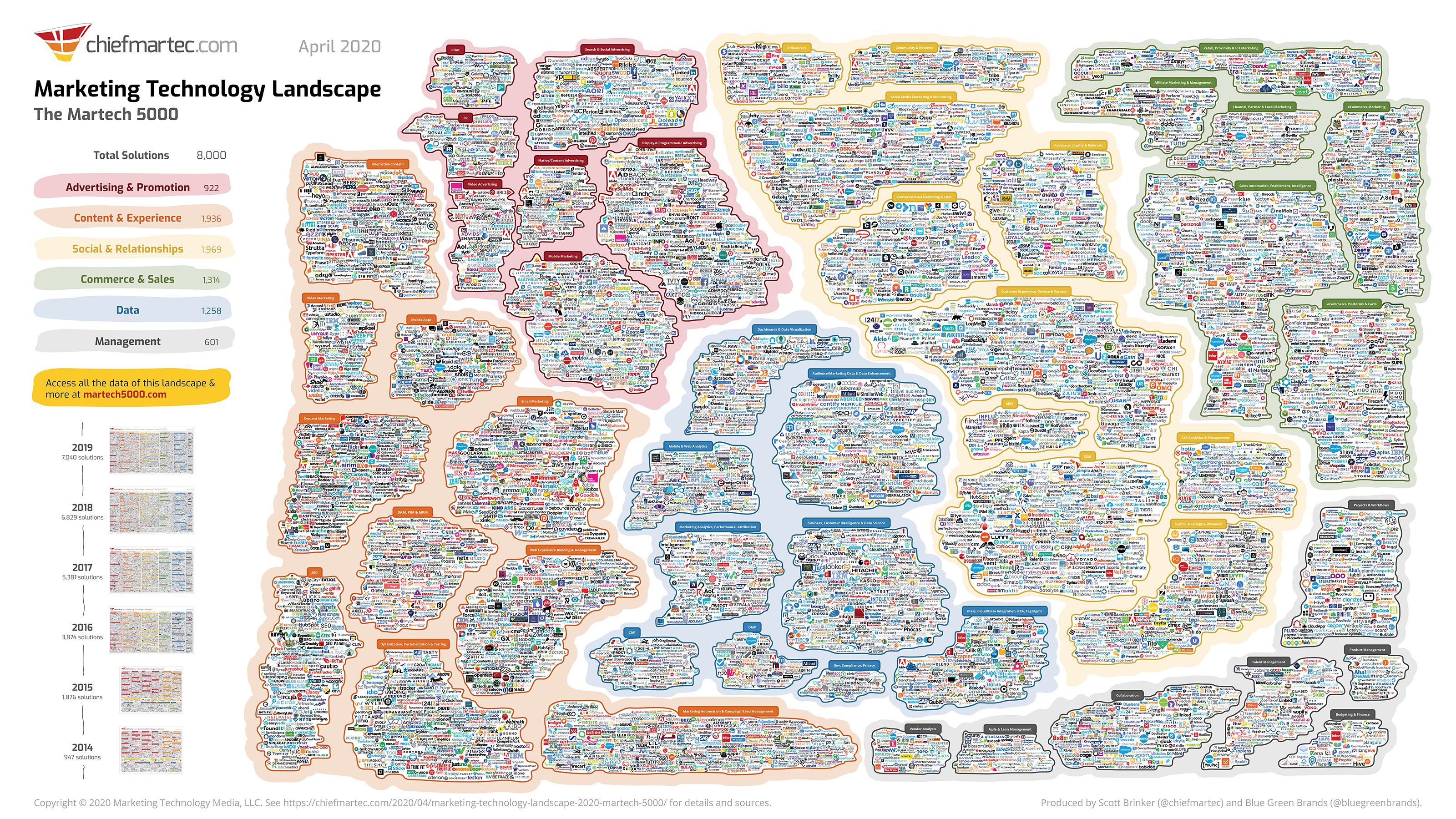
According to chiefmartec.com, in 2020, there were over 8,000 tech platforms! Click HERE to see their graphic and blow your mind.
In this 2016 VentureBeat article, their graphic depicts an extensive myriad of platforms to manage inside sales. Here we are in 2022, you can bet that the number of programs has multiplied exponentially.
Let’s dial it back to you and your set of tools and software programs.
Questions about your tech stack:
- Do the tools add to or take away from your collaboration?
- Do your tools add REAL value to your operations and desired outcomes?
- Do your apps offer full integration with each other?
- What would you lose if one of them shut down?
- Is there any redundancy in capabilities or features?
- Are these apps ALL on a do-or-die basis?
- Are there tools you can do without?
- Does the costing fit within or exceed your budget?
- Are you gaining a competitive edge or just using the latest tool?
What will you do with the results of your Tech Stack probe? It is up to you to vet each tool for value-add and benefits across your organization. The investment you make should meet your goals while supporting your team, collaborative partners and corporate mission.
If your tools fall short, or your tech stack looks more like a tornado of shiny objects, create a spreadsheet or chart of choice, to clearly outline the features, benefits, and costs. There’s nothing worse than worthless clutter.
What’s your plan to optimize your tech stack?

by Ace Concierge | Virtual Assistant | Nov 19, 2021 | Organization, Productivity, Time Management

If you work from home, your office desk may be hindering your productivity. Have you ever entered your office to find it in disarray? Or maybe you have spilled coffee or tea all over your desk?
That’s a case of having to get your home office desk organized urgently so you can get your work done.
But why wait until you spill coffee or soda all over your work?
Your Organized Home Office Desk Helps Increase Your Productivity
How you wonder? According to Forbes, the typical executive today wastes almost one month a year searching for lost information.
Imagine a whole month looking for something that if you were organized you would have saved that much time?
What would you do with a months’ time? You could actually take a vacation! Or work more and make more money and still take a 2-week vacation. Imagine that?
How to Get Your Home Office Desk Organized
- Take everything off your desk and dust it. Make it shine.
- Next only put your laptop on the desk.
- Then add items like a pen and pad near your dominant hand. If you have several pens/pencils, put them in a container and leave just one on the desk. This helps you focus more on one thing and not multi-task.
- Only keep what you need on your desk. Anything that you reach out for often or have to leave your desk for.
- Keep some open space, it helps your mind wander and be more creative. Creativity for running a business is important as you need to make changes and pivot for your success.
- Do not keep a pile of paper on your desk. Only the important few pieces.
- Next, make sure your laptop desktop itself is not cluttered.
- Keep a to-do list and schedule nearby on your office desk.
- Hang some inspirational quotes or photos on the wall of your home office.
Why Declutter?
By decluttering your office desk space, you feel better. When you feel better, you can work better and be more productive and creative.
Also start decluttering the other spaces around your home office desk. For example, drawers and shelves. Keep them simple and clean.
Next time when you enter into your office home space you will feel refreshed and ready to begin working. You won’t be thinking about all the stuff you have to clean as you work from home.
Organize the Rest of the Office
Now that you have your office desk organized, you can move on to the other areas of your room. Whether it be in the drawers or other pieces of furniture keep things to a minimum.
You may be surprised to see how much stuff you kept, that you didn’t really need. Maybe you can move some of your unneeded documents to a zip drive.
Anything to save on paper and clutter on the actual office desk and make you more productive.
Make it Your Own Space
Style your home office to your own flavor. Many may love the man-cave look for their offices and others want a more feminine touch. Whatever style makes you happy and feel good, is the style you will want to go with. Use your favorite colors for the paint, rugs, or furnishings in your home office.
Of course, feeling comfortable in your own home office will help you be more productive each and every day.
If you work off your dining room table, you may be easily distracted. You may also spend more time looking for things you need to get the tasks at hand done.
Working from a Clean Home Office Space
Now that your office is all cleaned up you will feel ready to tackle anything that comes your way. You will be able to find things quicker and get more done.
You may even be inclined to do other areas of your home to make the rest of your life more pleasant and stress-free. Having clutter can be a stressor for many people.
The less clutter you have, the fewer decisions you have to make, the less you have to look for stuff, and the less overall stressed you will feel.
You will be able to live more productively, happy, and be more successful in your business.
Guest Author Lisa Sicard
 Lisa loves helping others to thrive online through Social Media, Blogging, and SEO. What good is knowledge if you cannot share it with others? She has 30+ years of experience in marketing/advertising with 9 years of experience in content marketing, social media, blogging, and SEO. Check out her latest eBook “How to Tweet and Thrive on Twitter” now on Amazon.
by Ace Concierge | Virtual Assistant | Apr 15, 2021 | Productivity, Time Management

Time is not an infinite resource. If you waste even one hour, you cannot recover it. You cannot replace it. Time is perishable.
It is simply gone forever.
Take time to practice being conscious of how you ‘invest’ your time. Consider the actual number of minutes you spend engaging on your work and activities throughout the day.
Ask yourself:
- Am I fulfilled?
- Did my activities serve my goals and me?
- Did I invest in myself?
- Was my time on task meaningful?
- Did it deliver a daily impact?
- Was I able to drive my business forward?
- What was the ROI of my time?
If your ‘self’ is lagging, and not delivering measurable outcomes, perhaps it is time to evaluate:
- Priorities
- Focus
- Goals
- Time Blocking Strategies
- Desired Results
It can be uncomfortable to sit with yourself to examine your processes and achievements but as you begin to reveal your ‘soft spots’, you have the opportunity to create pivotal growth. This assessment initiates a deeper dive beyond the concept of time management. There is more than just the time in your life. In “It’s Not About Time”, David Allen called it self-management.
“The savvy know self-management is really an issue of what we do with ourselves during the time we have. Self-management is about knowing what to do at any given moment. It’s dealing effectively with the things we have to do to achieve our goals and fulfill our purpose.
Key Insights:
Managing oneself may offer greater insight than simply thinking about managing your time.
What we value is what we spend more time doing. You will always pay more attention to, and spend time on, what you value most, whether it is your family, career, health, social life, sports or social media and technology.
It is only by looking at how you spend your time that you will know what is important to you.
Weigh the return on investment of the time you are spending on an activity or project. Is it the best value of your time? Is it a diversion tactic to avoid a difficult project? What are you getting out of it?
Self-discipline accompanied by self-management help to drive your time more effectively and efficiently.
A moment lost, is gone to the ether.
Be mindful.
In an article by Anthony Iannarino, “Return On Time Invested,” he suggested measuring each activity, the time you spent, and the return. If there was no return on your time, then you must realize that that task or activity is not worth doing. A better use of your valuable time is to focus on those activities that produce a desired, profitable and rewarding outcome.
Leveraging your time and effort is a fundamental strategy for success. You can:
- Eliminate unnecessary activities
- Prioritize so you focus your energy on those tasks that provide the highest rate of return
- Set long and short term goals with action steps, motivating you and keeping you on target
- Learn how to effectively delegate
- Outsource non-core tasks/projects
Let’s close with a quote from Jack Canfield,
Most entrepreneurs spend less than 30% of their time focusing on their core genius and unique abilities. In fact, by the time they’ve launched a business, it often seems entrepreneurs are doing everything but the one thing they went into business for in the first place.

by Ace Concierge | Virtual Assistant | Mar 9, 2021 | Entrepreneur, Productivity, Time Management

Getting down to business is more than being busy. Busy focuses on getting things done and checking off items on a To Do List. It is easy to confuse being busy with being productive. As an entrepreneur, you’ve got an organization to manage, a product or service to market, and a team to lead but if you’re tied up dowsing fires, and making checkmarks, then your productivity level is probably waning. Put the fire chief hat on the shelf and consider results-oriented actions to produce measurable outcomes.
Busy is transactional behavior, a quick fix, not a long-term solution for success. Think in terms of transformation.
Transformational thought processes generate a foundation for infinite strength and durable business achievement. Productive people establish viable systems and processes to direct their attention to single tasks, minimizing diversions and distractions.
Busy people touch everything that comes across their desk, check email at every ping, lend an ear for text messages, maintain a side-eye on social media posts, fiddle here and there, and at the end of the day, have managed to spread themselves so thin, wondering where did the time go.
Choose to reach peak productivity levels on any given workday by forgetting about looking and feeling like a busy donkey and transform yourself into a productive unicorn today. Larry Kim
Busy people tend to ask, ‘What else can I do?’ Filling their day with a whirlwind of activities that can fuel the ego and make for great conversation at the (virtual) watercooler. The busy bees are intent on doing more, perhaps in a chaotic and unfocused fashion, accomplishing a myriad of micro-tasks to fill their day. Maintaining the busyness is also another tactic for avoidance and possibly not eating the frog.
In How Being Busy Makes You Unproductive, Travis Bradberry stated, The truth is, busyness makes you less productive.
Productive people ask, ‘What else can I remove?’ Productive people hone in on their talents, top priorities and core genius to drive their results. Fueled by purpose, they often check in with themselves, thinking about what they can do, dump or delegate.
I received an email from an exceptionally valued long-time client who shared her To Do list with me. She stated: “These are just a few of the things I need to grow my business – and I am failing at doing them, but when I do, it totally pulls me away from the work I NEED to do that is billable.”
Determining the greatest value of your time requires a little taste of honesty. While you may enjoy many of the daily business operations and social media fun, they aren’t your ticket to paradise. They are required fillers to help fortify your business structure but are hardly the top dollar shakers.
Everything we do is an investment of our time. In many ways, time is more valuable than money, as you always have the opportunity to make more money, but you cannot recreate lost or wasted time. It is gone forever. If you think of time as a commodity and all of your actions/choices as an investment, it may change the manner in which you approach your business operations and your life.
Stop doing stuff that isn’t valuable. So much of what people do in attempting to be productive involves just trying to fit more low-value tasks into the same amount of time. Being productive means accomplishing more with the same or less effort. Mark Shead, Productivity 501.
Transform your life and your business by not being busy. Be productive.
by Ace Concierge | Virtual Assistant | Dec 15, 2020 | Productivity, Small Business
If you find that you’re not crushing your productivity and things just aren’t getting done, then you may want to keep reading.
Organizing is one key component to your productivity and time management to bring you back to a central focus, keeping you on task and driven for success.
There are some simple straightforward, no-brainer things you can do every day. They don’t cost anything and they will only help you invest more in yourself, your business, and your time.
Maximize your time to work smarter, not harder. Let’s get started,
Productivity Simplicity
- Priorities: have them. Understand them. Commit to them. Determine what is most important in your day, life, and business. That’s what you need to be doing
- Make a plan: merely thinking about doing something isn’t enough to achieve important tasks and milestones. List out action steps
- Prepare for deviations: they happen. You will be sidetracked but with proper planning, you can quickly redirect
- Move your body. Exercise is a chief factor in your vitality and daily energy levels
- Do less, but do it more strategically by delegating, dumping, or deleting, leaving time for what’s essential for you to accomplish
- Set realistic timelines: deadlines keep you from scrambling and only half finishing your lists or not putting in 100%. If you can’t give it your all, then it is half-ass. Do you want that?
- Tick tock: don’t be ruled by the clock. It does not tell you if you are being more efficient and productive. Your output does. 9-5 does not mean anything if you are just “busy”
- Set goals: this helps to keep you on target daily, weekly, and monthly. Revisit your list and revise it as needed
- Eliminate your distractions: there is nothing worse than the ping of a notification, social media, TV, phone, etc that will detract your focus. Tune out and turn off. It is okay. You will not lose anything but you have everything to gain. Be in the moment and nowhere else
- Don’t multi-task: it does impede your productivity, decrease your brainpower, and limits your true attention to getting one thing right. Emphasize one project, one task at a time.
- Ask yourself, “How or does, this serve my goals?” If something doesn’t serve you, then STOP!
- Be accountable: yes, how you manage your day and your time is up to you and only you. Own it. Do it. Be the best boss of yourself
- Focus on results and outcomes, not busy time
- Timers: they work! Set a timer for 30 minutes that you will devote to the time on task. Do not stop. Don’t stray. Just do it. At the end of those 30, take a 5-minute break and then hit it again.
- Break the e-chains: don’t be held hostage to your email. Set a reminder from your timer in tip #14, to check your email 4X/day
- Review/Revisit/Revise: every night, review your day to set your goals/action steps for the following day. This is a key component to your successful productivity planning
- Shout, ME ME: yes, you must self-invest and establish a healthy work-life balance. Schedule in a time that is away from work; away from must-do’s and have some fun. Refresh and refocus your brain and your body
These action steps may seem like simple, common sense activities, but how many do you faithfully implement and maintain as daily habits?
Daily healthy productivity habits are the key to enhanced, quality output and measurable results. Nothing will change until you develop a consistent routine with firm systems, processes, and an understanding of your triggers that may set you off on a wanderlust of to-do list mismanagement. For example, eating 12 apples on a Saturday certainly won’t improve your health. Willy nilly organization won’t improve your results.
Get started TODAY. Forget about procrastinating, waiting for a better day, the right time, or perhaps, a New Year’s Resolution. RESOLVE to make daily changes for 365 days, every year. Consistency delivers results. Master your productivity with your commitment.

by Ace Concierge | Virtual Assistant | Nov 12, 2020 | Entrepreneur, Goals, Productivity, Time Management
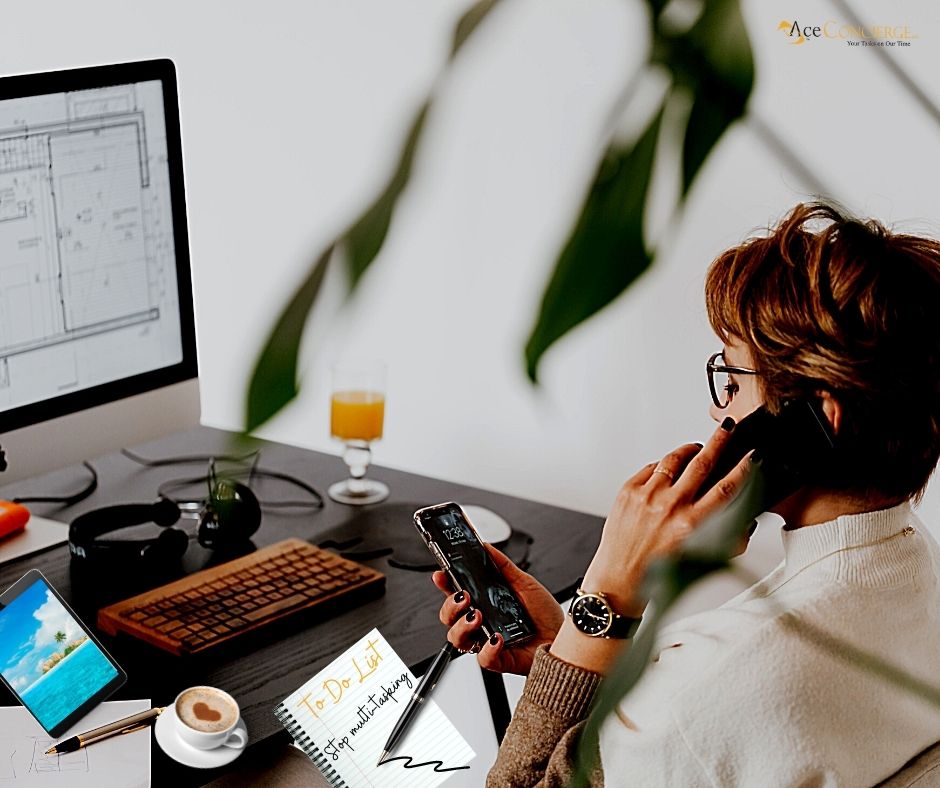
Our magnificent brains have a restricted capacity for devoting attention. When you multitask, you are not training yourself to manage more activities, but in fact, you are simply instructing your brain to take on more, with limited individual attention. It isn’t an act of increased productivity. It is distributing your focus over multiple activities simultaneously. You are more apt to forget, lose, or miss important details. You may think you can function on full throttle with a hoard of tasks, but it comes at a great loss. Consider it mental overload.
It is more important to be present and engaged with whatever you are doing versus being in the overtasked coma state. Your brain switches back and forth, stopping and starting whenever you choose to multi-task. Diverting your focus increases inefficiency, no matter how badly you convince yourself that you are the master. You’re not and it’s detrimental to your results.
While you can manage automatic, higher-level task switching like walking and talking at the same time, crafting an email, sending a text while Zooming a co-worker produces less than satisfactory results. Writing and speech-related tasks compete for attention in the prefrontal cortex. Some researchers suggest that multitasking can actually reduce productivity by as much as 40% and the number of errors can increase by 50%.
In an NPR interview, Stanford University professor Clifford Nass said ‘heavy multitaskers” have trouble tuning out distractions and switching tasks compared with those who multitask less The study revealed that even when chronic multitaskers were focusing on a single task, their brains were less effective and efficient.’
If you try to multitask in the classic sense of doing two things at once, what you end up doing is quasi-tasking. It’s like being with children. You have to give it your full attention for however much time you have, and then you have to give something else your full attention. Joss Whedon
Instead of consistently jumping around from project to project, create focused time blocks, turn off notifications, and tune out distractions.
Steps to STOP Multi-Tasking
- Set priorities
- Figure out exactly when you are most productive
- Reduce or eliminate distractions
- Turn off notifications
- Sign out of social media
- Time block your day
- Be present
- Finish what you start
- Don’t be afraid to say no
- Take breaks
- Be mindful of your habits and adjust accordingly
Take a step back and think of all of the times where you have been engaged in 2-5 activities at once.
Seems a little outlandish, right?
What were you able to:
1. Absorb
2. Contribute
3. Conquer
4. Complete
What will you do to minimize multi-tasking and commit your focus to a single project?